

Microsoft (NASDAQ: MSFT): The Governance Layer
A missed opportunity; What each business earns, why cloud margins are falling, and whether the annuity survives the agent

A note before the post:
Illiquid Alpha is about places the market isn’t looking, and Microsoft is one of the most-covered stock on earth. This is an exception, not a change of direction.
It’s here because the piece is really about being late: I finished the work a week after the price I wanted had come and gone. But I think it’s still work publishing - after all, my first Reddit post also said that, at the price back then, Reddit was not a buy. But I laid out my thesis and provided a target price, which I had acted upon since.
If you’d rather skip the US equity notes altogether, you can turn them off without unsubscribing: click here or go to Settings → Illiquid Alpha → Sections, untick Global Large Caps.
Personal observation and the First principles future of AI assisted work
Over the past two years AI has changed how much work I can get done, by a margin I would not have believed in advance. Since I am rather at the front of the adoption curve, the productivity gain is currently mostly mine because the competition has not caught up. But that can not last. As adoption spreads, the same competitive pressure that makes AI valuable to me will force everyone else to use it, and the net advantage compresses back towards zero. The gain does not disappear; it stops being an edge and becomes a requirement. Which means I will have to use more AI, more deeply integrated, simply to stay level. So will every other employee and business.
Why does this matter for Microsoft? Because what I actually do today is prompt Claude and Gemini for one thing after another, copying context in and results out by hand. It works, but it is still enormously wasteful, as I am still acting as the integration layer. What the work obviously wants is a single system that knows my context, decides which model should handle each request, and routes it there without being asked.
I find it very difficult to imagine that this is not simply how knowledge work operates within five years, and the reason is competitive rather than technological. It does not require a single further advance in model capability. Even if raw capability froze today, the gap between what current models can already do and what is actually deployed inside enterprises is huge. Thus, closing that gap through integration will be a large productivity event in itself.
Now, the question becomes, who will collect the benefit of AI, and how much can companies charge for a turn-key AI solution?
So the structure is this. The floor is the marginal cost of compute plus a normal margin, and it rises as usage intensifies rather than falling. The ceiling is the value created - for a worker made dramatically more productive that is theoretically a large share of their salary, though it is a purely theoretical ceiling that no competitive market reaches. Where the price actually lands is determined by where the cost of compute settles, which is far below the ceiling and - due to even increasing usage - likely materially above where prices sit today. At USD 100 a seat a month you are at 1.5% of an USD 80,000 salary; at USD 200 you are at 3%. Neither is remotely constrained by the customer’s willingness to pay. Both are several times today’s pricing.
The obvious bull case would be that the provider captures something close to the value created - assuming this would be wrong, and telecoms is the cautionary case. Fibre and mobile networks generated enormous economic surplus over three decades and the operators captured very little of it, because bandwidth was a commodity, differentiation was impossible, fixed costs were vast and customers could switch. That is the right analogy for the compute layer, and it is a real bear-case risk for Azure, AWS and Google Cloud. But this does not apply for the identity, context and governance layers, which carry switching costs a cable never had. And this is precisely an argument for preferring the governance layer to the compute layer inside this business.
Which brings the question back to the one this article is about: it’s not about how much value AI creates, but who collects the slice. On that, Microsoft has a specific and slightly boring set of advantages - enterprise relationships built over three decades, an enterprise salesforce that reaches every CIO on earth, the institutional trust that means nobody is fired for choosing Microsoft, and the inertia of an installed base that has been running on its products for twenty years. It employs a lot of very capable people and has a demonstrated record of building new profitable franchises - Azure, Teams, security, now Copilot - roughly one every four or five years, each monetised through the same distribution. And it is positioning itself as the governance layer for agents, which is an attempt to collect a fee regardless of which frontier model wins.
The two Microsofts
Microsoft is running two main businesses lines with opposite economics. One sells software subscriptions at an 81.5% gross margin. The other sells compute at 57.1%, down 330bps year on year. The first grew revenue 14%, the second 32%.
The market spent twelve months deciding which one Microsoft is becoming, concluded it was the second, and then reversed the entire judgement during the past week. The shares peaked at USD 466 on 1 June 2026, but then fell and started trading in the USD 350-400 range into the 29 July results. This is also when I started to look at the company, as my preliminary analysis was showing that USD 350 could be the buy window - unfortunately I haven’t finished setting up my mind before the earnings, upon which Microsoft re-rated to just under USD 500. The ten-year average multiple is above 31x; the shares now sit at about 27x trailing earnings, against roughly 20x forward before the results.
Note on fiscal years: Microsoft’s ends 30 June, so FY26 Q4 is the June quarter and the fiscal year is complete.
Part 1 - The reframe
Software moats have historically rested on the difficulty of building software. If an enterprise-grade application took three years and forty engineers, whoever had already built it was safe. As coding is getting dramatically cheaper, that barrier is collapsing. And when building stops being scarce, it stops being where the profit is.
What remains scarce is everything else:
Customer relationship, track record and ease of integration - How difficult is it to switch / integrate the new software? Will you get fired for choosing this vendor & not everything goes according to plan?
Permissions - who is this agent, whose authority does it act under, what may it touch
Proof - what did the agent do, and can that be shown to an auditor in eighteen months
Integration into the record - where the output lives, who sees it, how long it is retained
None of the above are engineering problems - especially in the bullish AI scenario, engineering is getting commoditized. But that is not to say Microsoft is becoming a compliance and integration business. Microsoft is not becoming an integrator. It is changing the category of software it sells, from productivity software to governance software, while keeping the licence model and margin structure intact.
The evidence is in the new flagship bundle. M365 E7, launched 1 May 2026 at USD 99 per user per month, is E5 + Copilot + Agent 365 + Entra Suite. Three of those four components are governance products. Microsoft has built its most expensive seat ever and the majority of it by value is permission and proof rather than productivity.
Two months in, E7 has been bought by hundreds of enterprise customers covering millions of seats. Management explicitly credits Agent 365 - observability and manageability of token spend - as the component customers respond to. That is the thesis working faster than I expected.

In every row Microsoft concedes the capability layer and monetises the control layer. That is a deliberate repositioning onto the part of the stack that gets more valuable as capability commoditises.
The June-quarter confirmed this, with Agent 365, two months after launch, has nearly 40 million agents registered across tens of thousands of companies, and the usage of other 4 significantly up as well.
But, there remain risks. First, the moat and the antitrust target are the same object. A business whose value comes from being the mandatory checkpoint is, in regulatory language, a gatekeeper.
Second, toll economics decouple you from value created. A governance layer earns a fee per agent or per seat, not a share of what the agent produces. If agents generate enormous value, Microsoft collects USD 15 per user per month regardless. Being the toll booth is much better than being a prospector and much worse than owning the gold - and it is not what you want your primary business to be. This is also because, as you are becoming “the only bridge in town”, the upside you can charge for starts being capped by the government.
Third, it is an incumbency moat, not a capability moat. AWS has IAM. Google has its own identity stack. What Microsoft has that they do not is 450m seats of installed base.
Part 2 - The Office franchise
The numbers
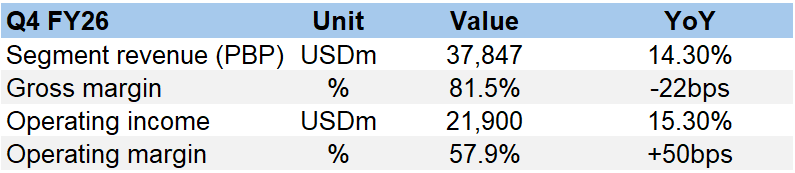
This was the first quarter in which serving Copilot visibly cost something at the gross line - hence why mild gross margin decrease. However, the operating margin was still ups 50bps YoY, meaning the franchise is currently not under pricing pressure.
For the future, growth comes from two main places. Seats: +6%, concentrated in small business and bottom-of-range bundles (low-ARPU clients), with no real seat growth coming from the existing enterprise base, as it is already fully saturated at c. 450m seats. ARPU is thus the key driver - Microsoft needs to move clients up the ladder, and management named Copilot, E5 and early E7 traction as the drivers for upgrades this quarter.
The ladder, post the 1 July 2026 increases is as follows: E3 USD 39 (from 36), E5 USD 60 (from 57), Copilot add-on USD 30, Agent 365 USD 15, E7 USD 99. At list, E7’s components would total c. USD 117, so it carries a c. 15% bundle discount to move a customer from 60 to 99.
To be noted, the blended realised ARPU across the base is roughly USD 19 per seat per month, not USD 60. Total revenue of c. USD 103bn across c. 450m seats comes to c. USD 229 per seat per year. This is because most seats are E3, Business or frontline packages at heavy discounts.
The moat
It is not in the applications themselves. Google Workspace has been cheaper, arguably better at real-time collaboration and aggressive in enterprise sales since 2010. During that period it has taken education, startups and much of small business, but has not taken the large regulated enterprise. That points to the fact that the product quality alone is not the moat here.
Surely, there is a better word processor somewhere out there, but Word is good enough and everyone else uses it. That combination - adequate plus universal - is far harder to attack than excellent.
What actually creates the moat then?
Identity. A company wanting to leave Office either keeps Entra, in which case it still pays Microsoft and has saved a fraction of the bill for an enormous project, or replaces Entra too, in which case the project becomes “re-do authentication for every application in the company”, with a huge security incident risk.
Compliance. In regulated businesses, documents are records subject to retention schedules, legal holds and eDiscovery. Purview enforces this. Migration to another project would be prove to document loss.
The bundle. E5 at USD 60 includes endpoint security, data governance, device management, identity governance and BI. Microsoft’s product in each category is usually not the best available - but it does’t need to be - it needs to be adequate and already paid for.
The buyer is not the user. The decision sits with a CIO and CFO negotiating a three-year agreement, whose incentives are very different to the underlying employees’. Neither will get fired for choosing Microsoft - but might be fired if he/she opts for a change of vendor, and change does not go smoothly.
There are some examples of this “bundle moat” working well. The EU forced Microsoft to unbundle Teams and sell suites without it from November 2025 - but Teams did not collapse and Slack did not recapture the enterprise. And on 1 July 2026 Microsoft raised prices c. 8% against a competitor bundling AI, with seats still growing 6%. Pricing power without volume loss is a proof of a moat.
Where the moat is not
Small business remains competitive. New companies default to competitors - Google Workspace, Slack, Notion and Linear. That does not hurt this decade, but it is how a moat dies over twenty years: not by losing customers, but by not being installed in the ones that get created.
This matters for how seat decline actually arrives. The intuitive bear case is that AI shrinks headcount at existing customers. The more likely mechanism is customer mortality - Microsoft’s installed base skews to large mature enterprises, and if those lose share to younger companies that never installed Microsoft, seats decline through the death and displacement of customers rather than through customers actually switching to competitors.
The seat question
A bear case is that AI writes the document, so nobody needs Word. But, if AI produces finished work that no human reviews or takes responsibility for, the white-collar worker has not lost their software - they have lost their job. There is no world where a knowledge worker exists, gets paid, and touches no document.
But if a human still reviews and signs off, they need an interface and permissions to open the document. That is a licence that Microsoft sells. If no human is involved at all, the question is not Microsoft’s Office revenue but the existence of white-collar employment, and Microsoft’s per-seat revenue is the least to be worried about in such a scenario.
To this end, Office is infrastructure, not a tool. It is closer to a monitor than to a specialised app. Someone who travels four days a week still has a monitor at their desk. Someone who delegates 90% of their drafting to an agent still needs to be able to open and edit the output.
But the number of seats remains a risk, as the revenue is seats times price. A firm employing 100 analysts to produce work might employ 20 to review it, and while each of the 20 needs a licence, 80 licences are still gone.
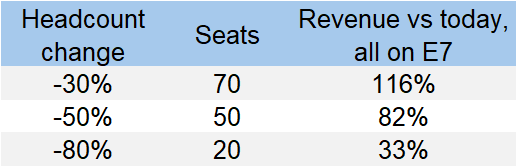
Going from E3 to E7 is a 154% price increase, but stops to hold revenue flat in case of around 50% headcount reduction. So the real question is not whether Office is safe or dead, but whether the price per remaining seat plus agent consumption grows faster than seat count falls.
What Copilot is worth if it works
Microsoft now has over 30m paid Copilot seats against c. 450m Office licenses - a 6.7% attach rate, up from 4.4% one quarter earlier. Every incremental percent is worth roughly USD 1.6bn of annual revenue at list.
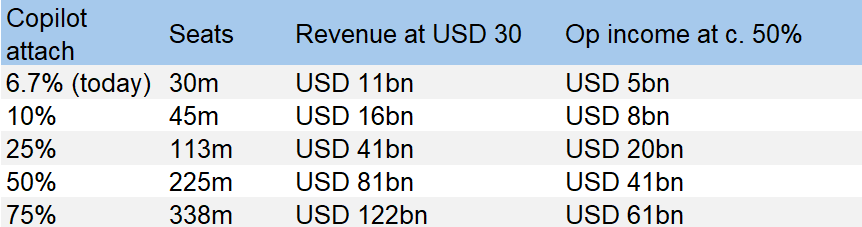
At 25% attach rate, Copilot alone would add c. USD 41bn of revenue and c. USD 20bn of operating income - roughly 13% of current group operating profit. At 50%, it approximately doubles the Office franchise’s profitability.
And the growth accelerated through the most recent quarter. Which comes back to the point I made earlier in the post: Microsoft is very cheap relative to what it is attached to.

Adding Copilot to an USD 80k employee costs 0.5% of that employee’s cost. It needs to deliver a 0.5% productivity gain - roughly one hour per month - to pay for itself. That is an extremely low bar, which explain why Microsoft has pricing power.
Google
I believe that the widely repeated claim that Google gives Gemini away free is wrong.
In January 2025 Google eliminated its c. USD 20 Gemini add-on, and included it into every Workspace tier, consequently raising base prices by roughly USD 2 per seat - a 16-22% increase, without any opt-out. Business Standard went from USD 12 to USD 14.
But the right comparison is the blended, not list price one:
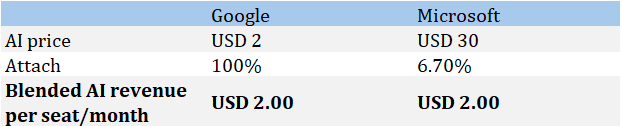
The two companies are now collecting exactly the same amount of incremental AI revenue per seat. Google’s rose prices for everyone by a little - and it did so by a little since most of them do not (yet) use the product. Microsoft, on the other hand, is concentrated in the minority who chose it and presumably use it.
Google sustains it due to not everyone using it - as soon as the usage picks up, Google will need to start charging more, hence why the headline USD 2 per seat is fake. But, admitedly, Google other key advantage is that it designs its own chips, and is thus the only fully integrated company in the industry.
And when we are at Google - Google’s search advertising business is not obviously safer from LLMs than Microsoft’s Office franchise is. That was the consensus worry when Alphabet was trading at depressed valuation in 2025. The stock has since recovered and the worry dissapeared, but nothing much has actually really changed - we will only know in several years. And the extreme AI scenario is far worse for Google than for Microsoft: in a world where agents do the work and humans stop browsing, search advertising has no obvious business model, whereas a governance layer still collects a fee while the agents work.
Part 3 - Azure and the margin question
The numbers
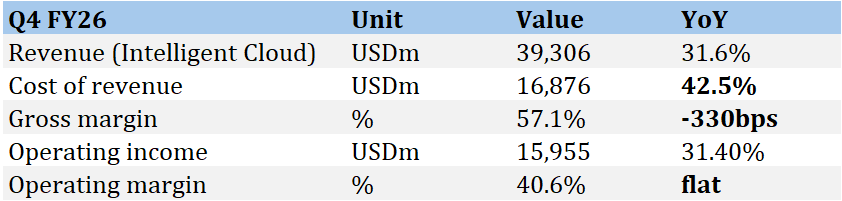
Azure grew 43%, accelerating from 40% in the March quarter, and full-year Azure revenue passed USD 100bn for the first time, up 41%. Microsoft Cloud gross margin was 65%, better than the c. 64% guided, and is guided to be roughly stable next quarter.
See below the evolution of margins:

In the latest quarter, both cloud margin series stopped falling and increased QoQ, while revenue growth also accelerated.
Is a falling gross margin bad?
Only bad if it reflects pricing pressure. It is fine if it reflects mix shift into a lower-margin but much larger business. Right now, the second is the case for Microsoft - management has said demand exceeds supply for seven consecutive quarters. You cannot be supply-constrained and price-pressured at the same time.
Why it is falling
Mix. Three sub-units with very different economics sit inside one business unit:

Classic Azure is still roughly 70% of the revenue, and it is a good business growing in the mid-twenties %. But growing the AI layer, which has lower margins, the fastest reduces the total margin down, even though classic Azure’s own margin continues rising with scale.
The depreciation debate
Capital expenditure does not hit the income statement when spent, but only once the datacenters become operational. Side note: for hyperscalers, majority of depreciation is already included within the gross margin. Two depreciation discussions all around the internet at the moment:
The lag: Current margins reflect capex from 2024-25, not the c. USD 190bn of underlying calendar-2026 spend.
Vintages stack: At roughly USD 190bn of annual capex, split two-thirds short-lived (chips, servers, storage) and one-third long-lived (shells, land, power), one year carries c. USD 24bn of annual depreciation. Holding capex flat they add up quickly:
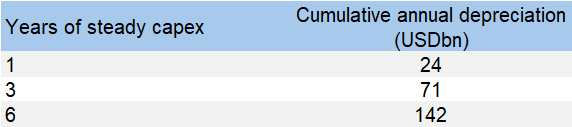
Even if Microsoft stopped capex tomorrow, reported depreciation would continue to climb in the future years, as the facilities currently under construction would come online.
But what is sometimes skipped is the fact that the same lag applies to revenue. A datacenter under construction contributes neither depreciation nor revenue. The USD 24bn of annual depreciation from the 2026 vintage arrives alongside the revenue that vintage was built to serve - and Microsoft is building it because customers have already contracted for the capacity; well, at least in part. Backlog now stands at USD 678bn, up 84%, with roughly 30% recognised within twelve months. So the depreciation issue is not arriving without offset; but indeed the question of how high the revenues will be remains.
Economics of a datacenter
Below are high level unit economics on a USD 1bn facility:
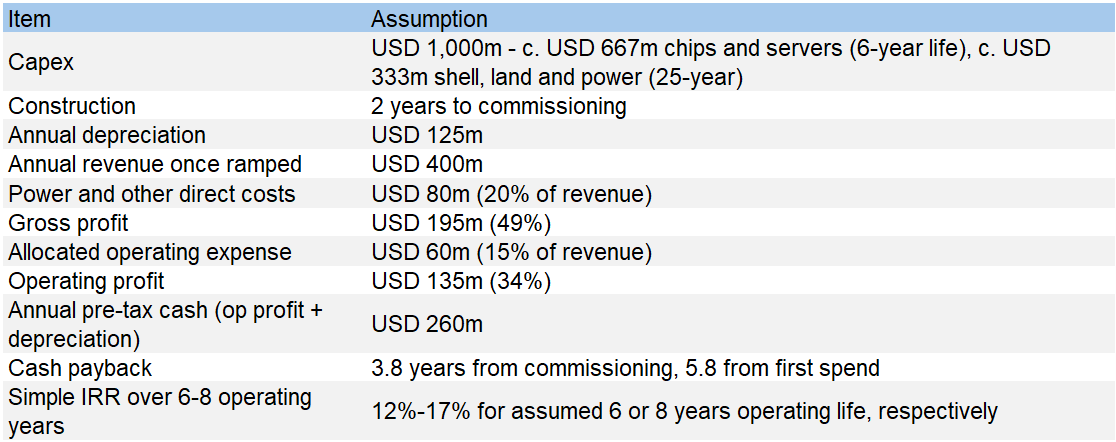
Key takeaways:
Accounting breakeven: revenue would need to fall to c. USD 192m - a 52% decline - for the facility to make zero operating profit. That, at the moment, is a rather wide margin of safety.
Cash breakeven is even lower, because once the money is spent, depreciation is a non-cash charge on a sunk cost. Any revenue above power and operating costs contributes cash. This is the point most bearish commentary misses: for an investor buying today, capacity already built is close to irrelevant even in a scenario where it never earns its cost of capital. The money is gone, the depreciation is non-cash, and it even shields tax. The loss would be real for whoever owned the shares when it was spent, not for whoever buys now - unless, of course, they are paying for its overstated future revenues. The real risk would only be a decision to keep spending USD 190bn a year continously going forward, into demand that does not materialise - and management can reverse such a decision, if unit economics start deteriorating.
Of course, for the calculation, as with any infra asset, it’s the last years’ - which are also the least predictable - that actually make the return. First 3.8 years are needed for the payback / break-even, while the “profit” is then only made on the last 2.2 years. If you get squeezed on the last 2 years, or your asset stop working, you don’t make any money, even if the first 4 years went according to plan. And while the first c 3 years are de-facto already contracted via the backlog, the last few years indeed remain at full “merchant” risk. More on that in the next chapter.
Key risks to this
Useful life. Microsoft’s currently depreciates computer equipment at 2-6 years (which are two thirds of total datacenter cost). But each year removed has a material depreciation impact (per each annual vintage):

This it repeats for every vintage. Michael Burry estimated USD 176bn of understated hyperscaler depreciation across 2026-28.
But, in my view, the more relevant question if the potential chip margin reversion. Microsoft is buying at the top of a supply cycle, while Nvidia is running gross margins in the low seventies and memory is also in shortage.
If we assume the compute supply chain normalises within three to five years, as supply chains do, this would likely bring Nvidia’s gross margins toward 40%. As a result, the same chips would cost roughly 55% less. Even excluding any additional losses due to lower performance of older chips. Microsoft would then be carrying c. USD 110bn per vintage of chip assets whose replacement cost had halved.
That matters because cloud pricing (in theory) should follow the marginal cost of new capacity, not the historic cost of installed capacity. A competitor building in 2030 at half the chip cost can price below Microsoft’s fully-loaded cost and still make money. Microsoft’s revenue per unit of compute would fall toward the new cost base while its depreciation would stay locked at the inflated historic cost (or - a write down).
Altogether this would mean c. USD 60bn of embedded overpay per vintage, which is c. USD 10bn a year of depreciation. That is, in my view, the capex bear case getting too little attention - not that the demand is fake, but that the assets are being bought at prices that will not persist, and that cloud pricing eventually reflects replacement cost.
Finally, one of the key reasons TSMC won the chip wars was that it was the only pure-play fab company, thus did not compete with it’s customers directly. From the customers’ perspective, there was neither the risk that TSMC would still their IP, nor that TSMC would prioritise it’s own capacity needs first. I see a non-zero chance that the same happens for datacenters - afterall, Microsoft surely already is prioritizing it’s own facilities for its own needs, then come OpenAI’s needs, and only whatever is left can go to thrid-party customers / clients. If a large independent competitor / neocloud (esp. once capex prices fall off) is to arrive, the industry might see a similar shift to such an independent provider. Microsoft could potentially be stuck with an overbuilt - however, due to overall short lifetime of datacenters (6y for chips vs 2y construction period for a new facility), the risk is somewhat mitigated.
Part 4 - Copilot, models, and who keeps the margin
What Copilot actually is
The key Copilot branded products:
Microsoft 365 Copilot (USD 30/user/month) - the paid assistant inside the Office applications.
Copilot Cowork (since June 2026) - asynchronous agentic work; delegate a multi-step task and it executes across M365.
Autopilots (introduced this quarter) - autonomous, long-running agents with full enterprise compliance, including an always-on personal agent.
Agent 365 (USD 15/user/month) - not an agent, but the control plane: identity, logging and conditional access for agents, including third-party ones
GitHub Copilot - coding
Microsoft has said it will consolidate chat, Cowork, Autopilots and Code into a single “super app” spanning consumer and commercial this quarter.
The adoption
Copilot now has over 30m paid seats, up from just over 20m in April and 15m in January.
Compared to 450m licenses, that is a 6.7% attach rate, while a surveys show that if enterprise users could choose freely, roughly 70% would make ChatGPT their primary tool, 18% Gemini and 8% Copilot.
To this end, Copilot’s growth is still driven substantially by procurement rather than preference - afterall, it is offered by a vendor companies already trust. That is the Microsoft’s moat.
However, this comparison still focuses on the wrong thing. Standalone assistants are still being judged on single-task quality. But Copilot’s proposition is integration: it knows the user’s calendar, mailbox, files, org chart and permissions without being told. While a user comparing Claude and Copilot on a discrete drafting task is comparing model quality, where Claude wins, a user asking “summarise where the XYZ deal stands” is asking a question a standalone tool cannot answer. It lacks the access - and in most large enterprises a new vedor will not easily be granted such access.
Microsoft’s own models
OpenAI, licence runs to 2032 but is non-exclusive, and Microsoft retains c. 27% ownership stake. But more importantly, MAI, the in-house family, if growing. Microsoft has announced multiple models across image, voice, transcription, coding and security, including its first reasoning model. Their edge is all about the cost savings, not the capability per-say.
The actual Copilot bull thesis
The market currently treats model capability as a single-dimensional race with one winner. That is unlikely to persist. Software did not converge on one application for everything; it split into many thousands of specialised tools. Models are already showing the same pattern - separate models for reasoning, code, transcription, image, long-context retrieval, and increasingly for specific verticals.
As the specialisation continues, competing to own the single best model becomes strategically pointless, but routing becomes the scarce function - sending each request to the cheapest model that can adequately handle it. An employee who sends a formatting question to a frontier reasoning model has burned perhaps fifty times the necessary tokens. Multiply by a large workforce and the routing layer can easily become worth more than the marginal model quality.
And this is what a wrapper actually does, and what Copilot is positioned to be. It also explains the margin structure. The router captures the spread between what the customer pays per seat and what the cheapest adequate model costs to serve - and that spread widens as open-weight models improve, because the floor on serving cost falls while the seat price holds.
Nadella highlighted this quarter the that every model should be substitutable. 90% of tasks can then be handled by the cheap in-house model, and 10% escalated to the frontier, with resulting cost halving for the same output.
This is why Microsoft’s lack of a frontier model matters less than it appears. The bar is to be good enough on the 90% of undemanding tasks, but retain access to somebody’s frontier model for the rest - and be the router.
It is also why open-weight models are structurally good for Microsoft rather than threatening. Foundry offers OpenAI, Anthropic, Meta, Mistral, xAI, DeepSeek, Moonshot’s Kimi and MAI. GitHub made Kimi K2.7 Code generally available in the Copilot model in July 2026 - the first open-weight selectable model, hosted on Azure. If a large fraction of token volume routes to models Microsoft hosts on its own chips at its own power price with no per-token payment to a lab, Copilot’s cost of goods can fall quickly.
Microsoft is thus deliberately commoditising the layer it does not own and defending the layers it does.
Part 5 - GitHub as leading indicator
GitHub is roughly USD 1-2bn of revenue against a USD 3.6tn company. Its importance in valuation terms is zero. But it does highlight a potential thread of Microsoft’s product suite overall.
GitHub Copilot launched into a new category and owned it. It now has 50m users, with over 90% of the Fortune 500. But have a look at the preference data:

Microsoft sold seats cheaply to the existing customer base, while challengers sold expensive tools to people who chose them.
Implications beyond GitHub? Coding may be the leading indicator for other knowledge work: it is getting the AI tools first and its buyers are the most discriminating. GitHub’s pattern - where incumbent won the seats, but challengers won the actual work - is exactly what would break the M365 Copilot thesis if it repeats.
The counter is that developers are unrepresentative. A lawyer or accountant does not install their own tools and will use what appears on their computer. Such defence, while correct, rests on customers’ inability to choose, which is what regulators are trying to erode.
Another lesson is that , while GitHub switched to usage-based pricing thus June, GitHub Copilot revenue still accelerated over 60% quarter on quarter, and seat seat growth remained intact. This implies that the incumbent could still monetise its existing base, while losing the preference contest.
Part 6 - Antitrust
Microsoft’s advantage is that it can make its own agent, identity system and audit log the default across 450m seats. That is also close to the definition of self-preferencing by a gatekeeper.
The Digital Markets Act (DMA) imposes obligations on gatekeepers in advance, without requiring proof of harm. Two of its listed core platform service categories are cloud computing and virtual assistants; its central prohibitions are self-preferencing and refusing interoperability. This is already being investigated and acted upon by regulators from various jurisdictions.
To this end, Microsoft’s Copilot auto-install into enterprise Office deployments in mid-2026 exempted the entire EEA. And while fines are noise, remedies could be impactful. What could matter is a requirement that Agent 365 treat third-party control planes on equal terms, or that Copilot is actually offered at an independent price. That would impact the terminal value / multiple, not near-term estimates.
On the positive side, heavy regulation raises barriers for everyone. Compliance costs are fixed costs, and a DMA-regulated agent market is one where a twenty-person startup cannot sell to a European bank at all.
Part 7 - Valuation
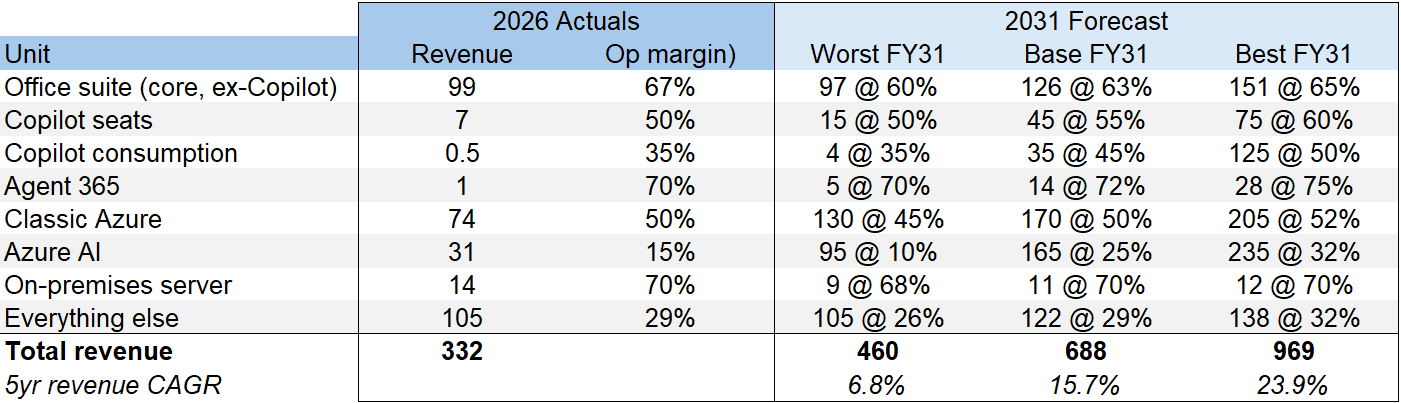
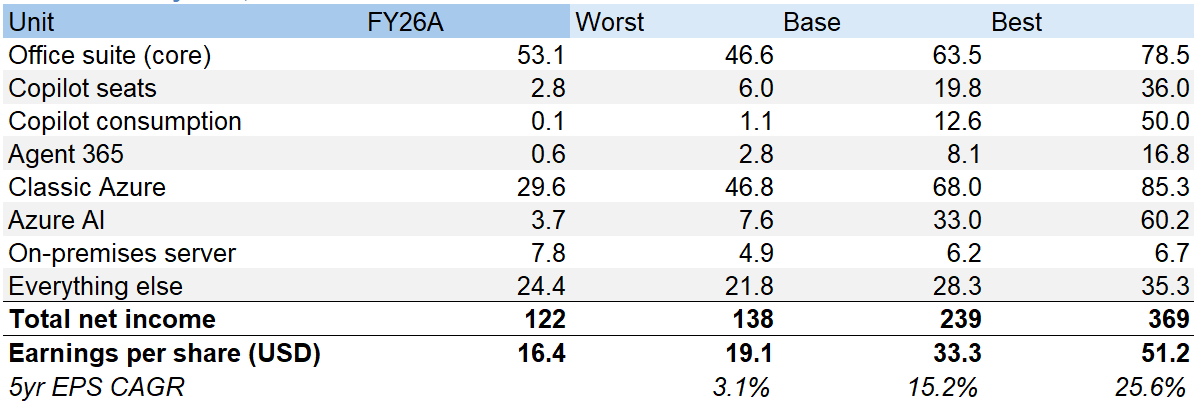
Method: Eight units, forecast five years to FY31, converted to net income at a 20% tax rate with a terminal price/earnings multiple applied and discounted back at a 10% cost of equity. Unit-level splits are estimates; Microsoft does not disclose them.
One note on reconciliation: the unit build gives c. USD 122bn of net income for FY26 vs USD 134bn reported, because reported net income includes USD 10.7bn of other income - largely the OpenAI and Anthropic gains.
I split Copilot into seats and consumption, because they behave differently: seats scale with headcount, consumption scales with work done. Agent 365 is also separate. However, it shall be noted that such purchases are correlated, because Agent 365 requires E5 as a prerequisite.
Revenue and operating margin
Net income by unit, after tax
Output
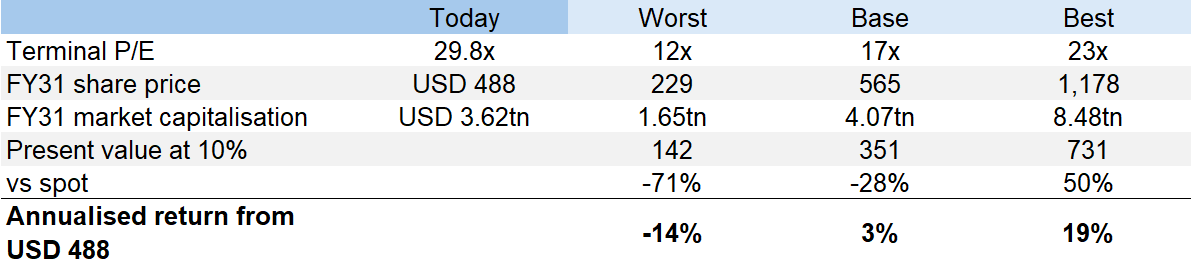
From the first principles, at a 4% equity risk premium over a c. 4.7% risk-free rate with a 75% payout, the justified terminal multiple is c. 14x for a business growing 4% in perpetuity. This implicitly assumes that Microsoft still has some growth left (beyond) inflation in 2031 - reasonable due to it’s implied market position under the base case scenario. However, 17x, which I actually assume, adds a small premium for what is not included in the forecast: Microsoft has built roughly one new USD 20bn+ franchise every four to five years - Azure, Teams, security, now Copilot - each monetised through the same distribution. You cannot forecast a product that does not exist, but you can pay for a demonstrated ability to create them. The best case holds (pre-earnings) 23x steady, which requires that Microsoft still looks like a fast-growing company in 2031; on those revenue numbers it would.
Copilot consumption is projected between USD 1.1bn to USD 50bn of net income across the cases - the widest spread of any business line. But this the only revenue stream that scales with work done rather than headcount.
What price makes investment worthwhile

USD 351 is where the base case delivers 10% a year, and it is the level I would have wanted to pay. Below that you are buying at a discount to a central scenario rather than a premium to it.
Key Risks
Copilot follows GitHub Copilot’s pattern. Renewals could start disappointing in FY28 as the first three-year cohorts come up.
Chip prices normalise and cloud pricing follows replacement cost. Assets bought at the top of the supply cycle carry depreciation a later entrant does not, while pricing, and in turn business-line’s revenue resets to the new cost base.
Useful lives shorten. A move from six years to four adds over USD 10bn of annual depreciation per vintage.
Agents go around Microsoft. Open protocols lets rivals reach enterprise data under without Microsoft.
Office suite gets threatened. While no longer the focus the business product, the Office suite is still what sticks a lot of moat together.
Conclusion - I missed the window
The model above says USD 351 is where Microsoft brings 10% a year in the base case. Microsoft traded in that range repeatedly over the past month, but I did not buy it. This is because I started seriously looking at the company too late, and then took too long to process it. My preliminary analysis was not - I was eyeing it at c USD 350 price target as per my July 28th post, but was not comfortable enough just yet.
But now, at USD 488 the base case returns 3% a year. That is not a short - but, considering still plenty of unknowns - is not a buy either. Microsoft is again trading at “Mag7 multiples”. In any case, with the “savings” I bought more Reddit in Friday, so not all is terrible. Maybe Microsoft corrects again, and then, like with my Reddit piece, the price will once again drop into my target range. We shall see.
Nothing here is investment advice. No position. Figures are from Microsoft’s FY26 Q4 results and earnings call of 29 July 2026, company filings and product documentation, with market share and competitor data from third-party estimates and peer disclosures where noted. Unit-level revenue and margin splits are the author’s estimates; Microsoft does not disclose them.