Reddit's Last Logged-In Quarter
App store rankings suggest the US logged-in DAUq scare is set to reverse - a Q2 earnings preview.

The perfect storm is brewing for Reddit ahead of the Q2 earnings. Ad quality continues improving, all the while the biggest scare of recent quarters - stagnating US logged-in DAUq - is set up to (artificially) improve this quarter. All of it is visible to any observant user of the platform.
I believe social media companies are among the easiest stocks to disagree with Wall Street on - because you use the product. Better yet - you are actually the product; anyway, you see the developments in real time - and that is something the historical numbers don’t show.
Disclosure: I am long Reddit, and I am considering adding into the earnings (details at the end). Nothing here is investment advice.
First, a story from way back
Let me take you back to late 2010s - an age ago in social media terms. I was interning at one of the larger media agencies, and, as is appropriate for an intern, was handed the task no vetted employee wanted: the entire digital media advertising budget of the agency’s largest client. That is how seriously digital ads were taken back then.
Meanwhile, I watched my senior colleagues allocate the TV budget. “Yeah, I’ll put one here at 10:30 on Sunday to get some more exposure” - proceeding to pick the most expensive slot available. No historical data, no measurement, nothing - pure vibes. They should try trading. My “stupid intern task”, meanwhile, tracked CPC and CPM to two decimals. Seeing both side by side, it was obvious who would win.
Fast forward to late 2018. While browsing Instagram, and being already generally bullish on digital ads and Meta (back then Facebook), I start noticing a very significant uptick in ad load. At some point it hits me: if ad load has increased by this much, it must show up in the next report. But am I the only one seeing this? I check with a few friends across different countries - all confirm seeing a lot more ads recently. Bingo. There is no real news of the ad load increase anywhere online, nobody is posting about it, and analyst consensus - I guess - isn’t taking it into account. I do some research and calculate the implied impact: an extra c USD 500m in quarterly net income. I was already bullish on Meta, and this extra USD 500m - not priced in - represented an almost 10% jump in quarterly net income. Significant.
So I make a post on r/wallstreetbets – which back then it was the only sub with a meaningful audience for discussing stocks on Reddit. Here’s the full post, with excerpt below:

Incidentally, everybody was freaking out at the time about Facebook “losing users”, and how the whole company would go bust tomorrow because of it. Reminds you a bit of Reddit (logged-in) DAUq situation today?
Aftermath: against analyst expectations of USD 6.28 billion in Q4 2018 net income, the actual number came in USD 600m higher, at USD 6.88 billion. David Wehner, then CFO, on the Q4 2018 earnings call:
In Q4, the average price per ad decreased 2% and the number of ad impressions served on our services increased 34%. Impression growth was primarily driven by ads on Instagram, including both feed and Stories, as well as Facebook mobile News Feed.
The stock shot up 11% the following day, attributable to earnings beat from Instagram side - and that was back when such moves were not yet an everyday occurrence.
Coincidence? I don’t think so. To an observant Instagram user, the coming earnings surprise was clear - it’s just that Wall Street didn’t use the app, so didn’t see it. And the exact same dynamic is, I believe, playing out for Reddit right now.
Where we are with Reddit today
Logged-in US DAUq
Stagnating logged-in US DAUq has been one of the street’s main worries in recent months, and one of the main reasons behind some of the steep price drops, despite otherwise stellar earnings.
I covered the logged-in vs logged-out DAUq topic extensively in a dedicated post here: The Stagnation of Reddit’s US Logged-in DAUs: Signal or Noise?
The most relevant extract is the following quote from Reddit’s Q4 2024 earnings call:
If you’re coming from search, we actually used to be more aggressive... we’d say ‘Hi, download the app, log in.’ That is a classic case of it works in the short term, it moves the numbers and it doesn’t work in the long term. It annoys people... We’re trying to make our customers happy. What are they there for? Answers - give them answers... They’re not looking to join a community in the moment.
So Reddit deliberately never pushed for app downloads or log-ins, optimizing instead for organic traffic growth. It is a simple trade-off: forcing downloads or log-in too aggressively risks alienating (non-frequent) users from coming back for their answers over the medium to long term. All the while, management has kept reiterating on recent calls that, thanks to improved predictive targeting, logged-out users are now monetized at a similar level to logged-in ones - making the distinction increasingly arbitrary. Frankly, it was always a somewhat pointless split; plenty of other cuts would be more informative. Splitting DAUs by amount of visits, for instance: users visiting an app 10 times per day for 15min per-session vs user visiting 1x per week spending 5min clearly have vastly different monetization potential - likely a bigger differentiator than the log-in status.
But what has changed now? In the Q4 2025 shareholder letter, management announced it would phase out the logged-in vs logged-out reporting, with Q2 2026 the last quarter for the split. The market freaked out - stagnating US logged-in DAUq plus discontinuing the metric read, to many, like hiding a problem. Again, I already covered this in my previous piece, so will not delve into the topic here - but it’s not a problem.
Now, ask yourself: if you are a rational Reddit manager, what would you do for this final reporting quarter? I know what I would do - I would temporarily turn the log-in/download prompts back on, showing logged-in DAUq growth in the metric’s final quarter and calming the market on its biggest worry. This metric is trivially easy for management to “play with”. You want more logged-in DAUq? Prompt users to download the app and log in. Logged-out DAUq takes a small hit, but logged-in reliably increases. And since the split will no longer be reported afterwards, they can revert to normal from Q3 onwards - if they want to. It is the lowest-hanging fruit imaginable: one quarter of prompting will not alienate many users, and if nothing else it provides a valuable experiment on long term user retention.
And indeed - right at the beginning of Q2, miraculously, Reddit users started reporting pop-ups pushing the app install and / or log-in when visiting Reddit outside the mobile app (or even within the app). Right after, Reddit’s app store ranking spiked. A few example posts:
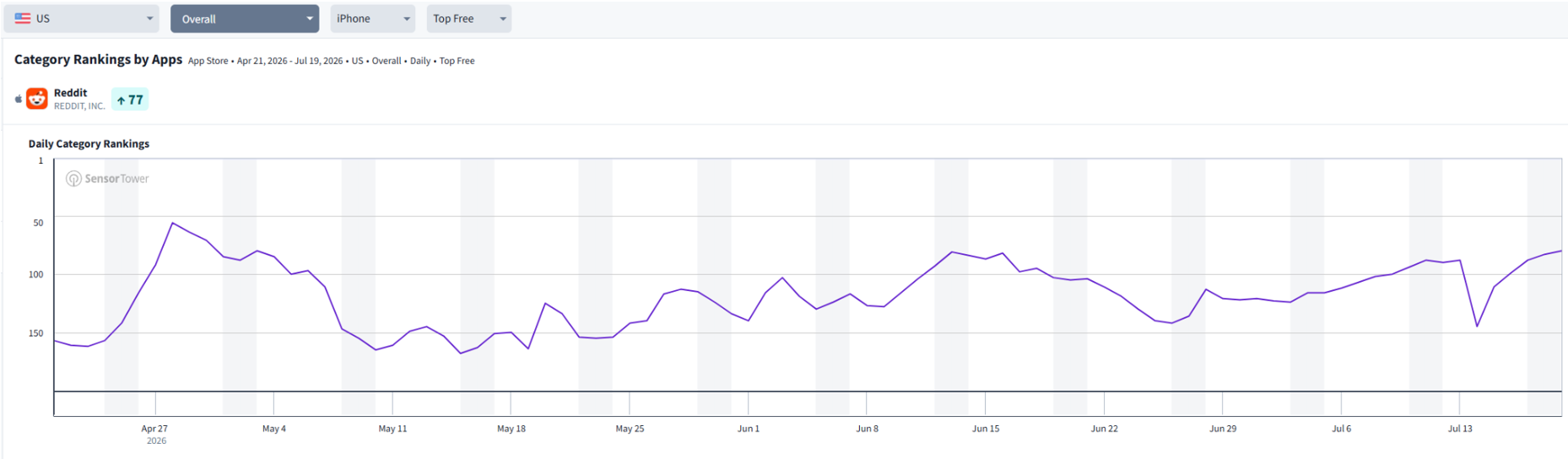
I tested this myself - opening Reddit in an incognito browser tab indeed threw up a log-in prompt, and even now, if using a VPN, I can no longer access the Reddit website without logging in. This should naturally increase app downloads and, in turn, logged-in user growth. The effect immediately in the iOS App Store download rankings: Reddit jumped from position #162 to #78 in the US during late April, with similar moves in the UK (#180 to #85) and Germany (#194 to #144).
Looking at the US, which is the core focus of the market, Reddit consistently ranked in the 150-200 range on iOS throughout February - early April, then suddenly spiked by c 100 places into late April:
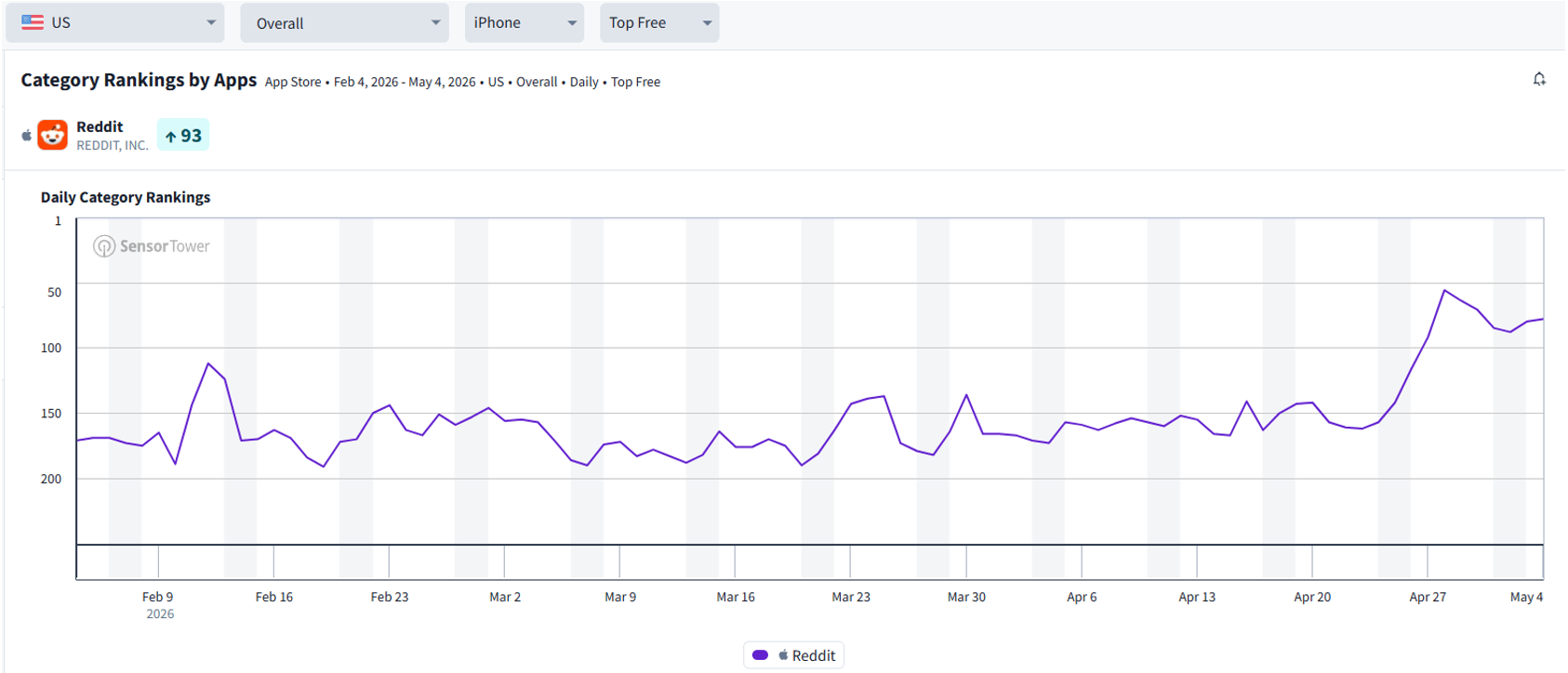
While the position has since partially retraced, it remains around rank #100 on average - still significantly above the pre-April #150–200 baseline.
Mind you, we don’t need a major increase in US logged-in DAUq. The market expects the number to remain flat, so essentially any tangible growth is a positive surprise.
Back-of-the-envelope: using a power-law distribution of app downloads by rank, moving from c #170 to c #100 in the US App Store implies roughly 10k incremental daily downloads - call it c 1mio incremental iOS downloads over the quarter, or c 1.5mio including Android. These downloaders are higher-intent (they were actively prompted mid-task), so let’s assume 75% of them log in.
But, importantly, new logged-in account is not a new logged-in DAUq. DAUq is a daily average, and most users do not visit daily. We need to estimate also the “compression ratio” between weekly active uniques (WAUq) and their daily-average contribution (into DAUq). In the US in Q1, DAUq was 53.5m against WAUq of 196.5m, a ratio of c 0.27. In other words, the average US active (weekly) unique shows up on fewer than 2 of 7 days, and each incremental active user adds only c 0.27 of a DAUq, not one.
And for the users a log-in prompt actually catches, even 0.27 is likely generous. The number is an average that includes the heavy users, which mostly have accounts already; a lot of the marginal converts would be in the lower-frequency tail - the twice-a-month Google drop-ins - whose personal compression sits below the blended average. Let us then assume that the applicable ratio would be c 0.10-0.25.
So: c 1.1mio converts times a c 0.10-0.25 compression ratio gives roughly 110k-275k of incremental logged-in US DAUq from the app-download channel alone. This would be further aided by the web and mobile purely log-in prompts - which convert existing logged-out visitors with no app download - and the total should be comfortably in the low-hundreds-of-thousands. That would take US logged-in DAUq from 23.2m in Q1 to somewhere around 23.3-23.5m in Q2. And that does not include the people who would convert either way (the “organic” converts) - though those were indeed at net zero over the recent quarters.
The precise figure does not matter, and I want to be clear I am not claiming a large logged-in beat - by nature, these are low-weight users, so the effect is modest. What matters is the sign. The market expects the metric to come in flat, as it has been for four straight quarters. Every version of this calculation, however conservative the compression ratio assumption, produces a positive number. Against a market expectation of zero, modestly positive is the whole surprise.
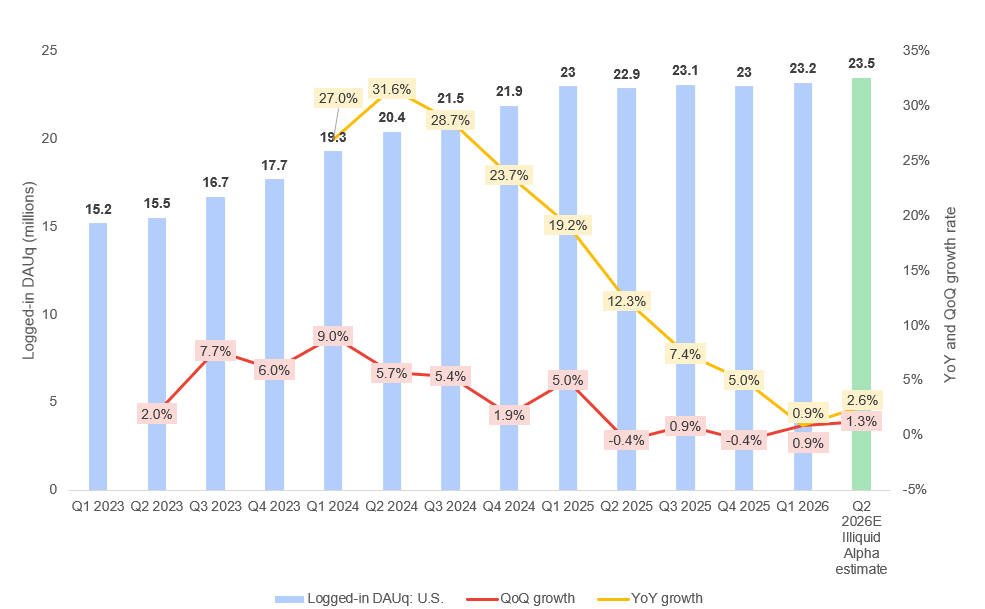
I believe this should calm the market on one of its main worries about the stock – a fitting send-off for the metric’s final reporting quarter.
Analyst consensus
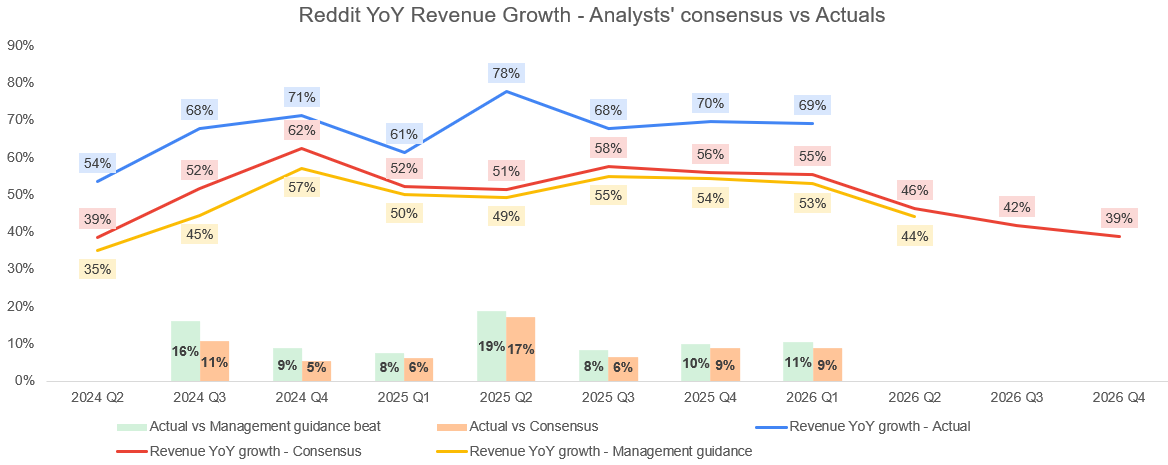
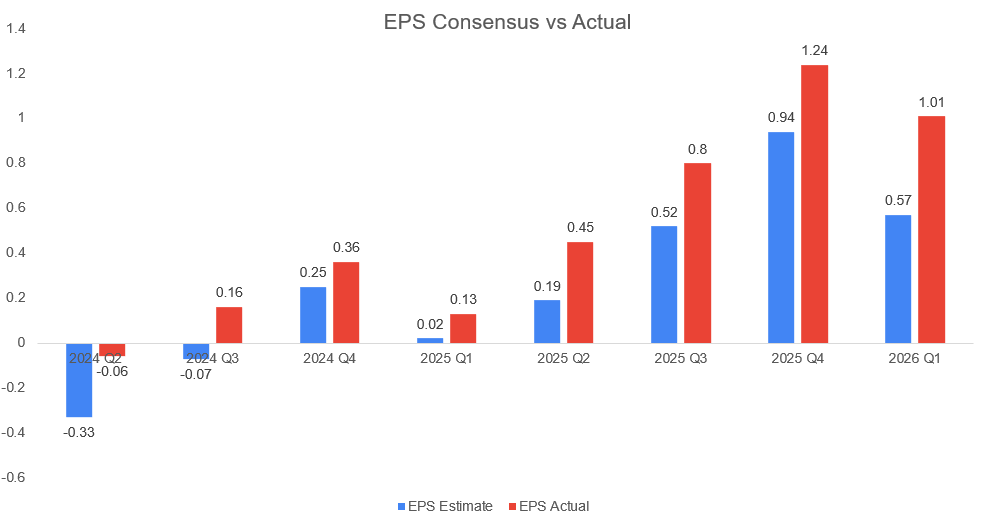
Another topic I’ve covered extensively in previous posts: analyst consensus for Reddit is not very meaningful, and consistently undershoots. The mechanism is simple - consensus anchors to management’s own quarterly outlook, which is itself always conservative. Both have somewhat shot themselves in the foot: management has “prudently” under-guided so consistently that the market now expects the beat, and if Reddit merely hits its guidance, the stock will probably tank.
See below - for the past two years, consensus has followed management’s forward guidance closely, recently ending up only 1-2% above it on revenue. The actuals, meanwhile, have consistently landed c 10%+ above management guidance.
Similar on the EPS side:
My estimate
Now, actually estimating current-quarter revenue from hard data is essentially impossible, at least for a retail investor - Similarweb and Semrush traffic data shows no reliable pattern against past quarters, and due to the on-going rapid Google Search algorithm change,s they are producing more and more noise each month. What you can do, as a user, is observe the platform itself. Throughout Q2, I continued to see major improvements in both ad quality and advertiser quality - to the point where, for the first time, I actually stopped and clicked on a few ads (no purchase yet, though). The ads finally became, in my view, “decent” during Q2. Far from Instagram level, but at least catching my attention. To this end, there is no observant-user-platform reason to expect a slowdown.
So instead of estimating revenue bottom-up, we can frame Q2 through Reddit’s historical outperformance versus its own guidance. Sounds a bit voodou, I know, but that’s all we have to really work with. Listen up.

Management guided Q2 2026 revenue at USD 715-725m (I use the USD 720m midpoint). Unlike revenue, historically, the costs guidance has been broadly accurate, so I take the guided c USD 430m of costs and scale them up with implied 20% incremental opex for any dollar of revenue beat (roughly in line with recent opex over-runs on revenue beats). I take SBC as per management guidance - up 23% YoY due to the new award program kicking in during Q2 (gg Jen). Notably, that is a c USD 40m step-up from Q1, which will be a significant drag on sequential EPS and incremental net income margin for the quarter. From there, three cases:
Worst case: revenue exactly at management guidance midpoint (USD 720m, +44% YoY) - i.e. the first zero-beat quarter in the company’s reported history. 1% increase in diluted share count QoQ is assumed due to new grants kicking in in Q2;
To clarify, as per the previously outlined own experience while using Reddit during Q2, I see no reason how actuals could come up below management guidance, hence this is a solid Worst Case
Lower Bound case: an 8% beat versus guidance (USD 778m, +56% YoY) - in line with the lowest historical beats (Q1’25 and Q3’25). Same 1% diluted share count increase as per Worst case;
Upper Bound case: a 15% beat (USD 828m, +66% YoY) - matching, but still below, the largest beats of 16% and 19% in Q3’24 and Q2’25, respectively. No QoQ increase in diluted share count assumed - i.e. buybacks to fully offset the increase
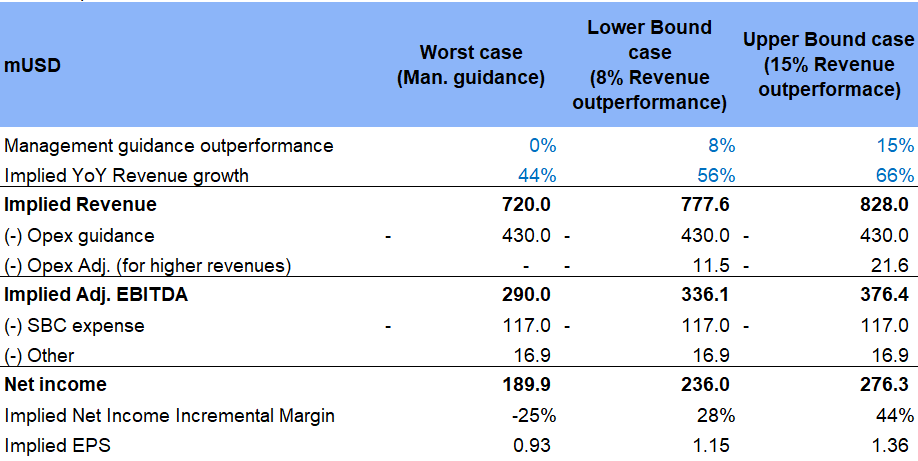
Even the Lower Bound Case, note, requires nothing heroic - just Reddit doing what it has done, at minimum, in every single quarter since listing. And that case would deliver Revenue of USD 778m, with an EPS of 1.15.
Market expectations
Since the market already prices in a beat versus management guidance, the more useful question is how my Lower Bound and Upper Bound cases sit against market expectations rather than company guidance. The best publicly available source here is Estimize, which has Q2’26 revenue at USD 760m and EPS at USD 1.13. On that benchmark, even my Lower Bound case lands slightly above on both metrics. The caveat is significant, though: Estimize’s Reddit forecast is based on fewer than 15 contributions, so I would not lean on it heavily. Earnings Whispers, by contrast, has EPS at USD 1.26 - which under my model would require c 12% topline outperformance versus guidance. Essentially, precisely estimating what the market truly is expecting is not possible.
For a name like Reddit, though, three things drive the reaction: revenue, (logged-in US) DAUq growth and forward guidance. On revenue, the (admittedly weak) Estimize benchmark suggests we are covered. On DAUq there is no consensus to benchmark against at all - analysts do not even forecast it - but for the reasons set out above, I expect a positive surprise. And finally, I believe guidance for the next quarter should hold up, given the noticeable & continued product and ad improvements seen throughout Q2. None of this is quantitative or provable; it is a qualitative judgement call. But I think the odds sit clearly on the side of a beat.
Conclusion
I believe this is setting up to be a great quarter for Reddit - primarily due to the coming US logged-in DAUq “surprise”, with the app download data already confirming the setup. Additionally, ads have legitimately gotten better again, and there is no reasonable basis for a negative revenue surprise: merely repeating the smallest historical beat lands revenue around USD 778m, which seems in line and even slightly above the market’s expectation. The problem with revenue is two fold: it is hard to estimate it, and also hard to know what the market expectation is. So we revert to a simple user-experience check, which implies revenue & guidance should do just fine, while adding on top the DAUq surprise. Together, those, in my view, mean that beat is more likely than not, and when the odds are in your favour, you should bet.
To this end, I naturally remain long with my core position, and am also planning to add a smaller “earnings play” position into the release via RDTL (the GraniteShares 2x daily levered long RDDT ETF). To be clear on the latter: daily-levered single-stock ETFs are a short-term earnings-event instrument, not a holding - size accordingly.
Disclaimer: This is not investment advice. I hold positions in the securities discussed and my views are biased accordingly. My positions, and plans thereof are subject to change without notice. Do your own research.