The Briefcase Problem: ACI d.d. (ZSE: ACI)
Irreplaceable natural monopoly with 22 marinas, EUR 45m of cash on EUR 89m market cap - but still not a buy

Imagine someone offers to sell you a briefcase with 1 million of cash inside. But there are some rules:
i) The briefcase pays out 10k per year, in perpetuity
ii) You can never open it and access the actual money
iii) If you ever want to sell it, the most anyone can pay you is 200k
How much is that briefcase worth? Probably not 1m. The money inside is real, you just can’t get to it. What you have is a 10k annuity plus a lottery ticket that someone, someday, changes the rules.
Below is a deep dive into such a briefcase trading on the Zagreb Stock Exchange (Croatia).
The pitch that sounds too good to be true
ACI d.d. (ZSE: ACI) operates 22 marinas with over 6,000 berths along the entire Croatian coast, representing the largest marina chain in the Mediterranean. These are irreplaceable assets with high pricing power: since EU accession, permitting a new marina on the Croatian Adriatic is close to impossible, and ACI holds some of the best locations, assembled decades ago when nobody else was competing. Its 23rd marina, currently under construction in Rijeka under a 50:50 partnership with Lürssen (admittedly a bigger, superyacht-grade project than the existing portfolio), carries an investment value of c. EUR 50m, before cost overruns – and that’s for a single marina with 230 berths.
The financials, at first glance: c. EUR 40m of revenue, c. EUR 10m of annual operational cash generation (EBITDA), market cap of EUR 89m, and EUR 45m of cash and term deposits sitting on the balance sheet against minimal debt. Strip out the cash and you are paying an enterprise value of under EUR 50m - roughly 5x EBITDA and around EUR 8k per berth - for a monopoly asset class that private equity is falling over itself to buy.
And they really are. Literally this week, CVC sold D-Marin - the closest regional comparable, with 28 marinas and c. 14,300 berths across the Mediterranean - to InfraVia for over EUR 1bn, roughly 15x EBITDA and c. EUR 70k per berth. ACI trades at close to a 90% discount to that on a per-berth basis (granted, D-Marin’s marina’s are more upscale, but still a stark discount).
So: unbelievably undervalued. BUT. Essentially all of ACI’s concessions expire in 2030. The Croatian state owns c. 79% of the company and runs it accordingly. The free float is under EUR 20m and the stock barely trades. After a lot of thought, I decided not to take a position. Here is why.
The asset
ACI was founded in 1983 and built out its network when the Adriatic coast was still open for development. Today that network cannot be replicated. The Rijeka datapoint implies c. EUR 200k per berth for a new premium build; even a conservative blended EUR 40-80k per berth on ACI’s c. 6,000-berth portfolio gets you to EUR 250-500m of replacement value. And replacement is mostly theoretical anyway - environmental and maritime-domain permitting means very few new marinas will ever be built in Croatia. Scarcity value on top of replacement cost.
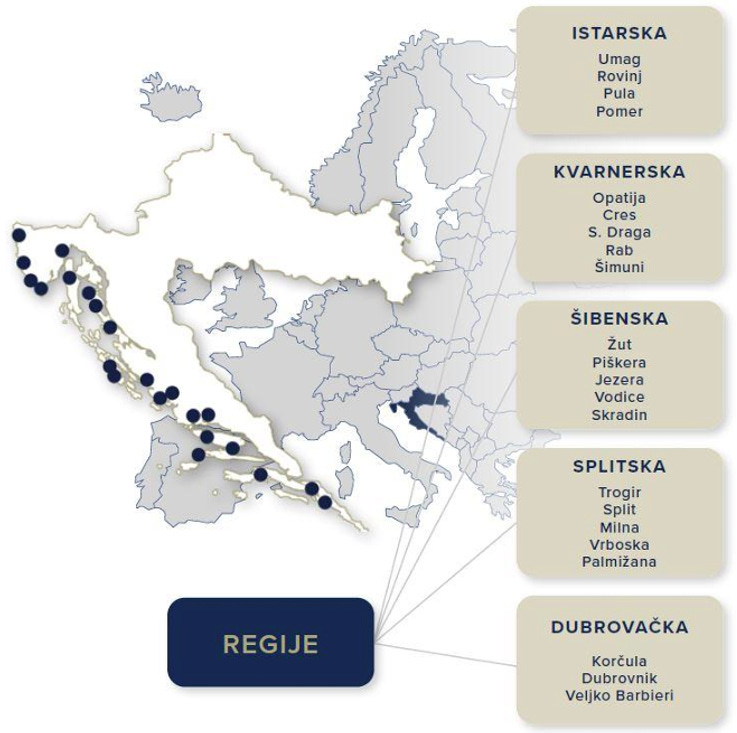
Below the locations of ACI’s marinas:
The concession cliff
When it comes to concession topic, there is currently a structural problem in Croatia. ACI’s marinas (as well as all other marinas) sit on “pomorsko dobro” - Croatian maritime domain, which cannot be privately owned and can only be leased out via 20-50y concessions. In addition, at concession expiry, everything built on it (piers, breakwaters, buildings) is legally part of the public domain and reverts back to the state, without any compensation. One of ACI’s anchorage concession expires in 2026, one marina in 2027, and everything else during 2030.
Due to this reason, ACI’s capex has collapsed to bare minimum in recent years - EUR 1.4m invested in all of 2025 (vs EUR 9m of annual D&A) - because management openly states that investing into concessions expiring in four years is uneconomic. A EUR 13.5m capex plan for 2026 exists on paper, likely contingent on the extension.
ACI has formally requested extensions based on its historical over-investment relative to the concession contracts, and a government decision has been expected imminently for months. The complication: under EU rules concessions generally must be tendered, and Croatian law only allows extension without tender within limits - so this is genuinely uncertain, not theatre.
That said, I think the concessions are, in practice, rather safe. First, the state owns the company - the government tendering its own marinas away to third parties would be self-harm. Second, this is not an ACI-specific issue: the whole Croatian marina sector operates on expiring-in-2030 maritime-domain concessions, and the entire industry is holding back capex because of it. A model where nobody invests in the country’s most valuable tourism infrastructure is obviously broken, and the state will have to fix it - for everyone. Third, the D-Marin sale is instructive: InfraVia just paid over EUR 1bn for a portfolio including Croatian marinas carrying the same concession-renewal risk. Sophisticated infrastructure capital clearly believes Med marina concessions will get rolled.
Indeed, assuming this would be a for-profit ran company, the worst case would have been well covered – EUR 45m of cash on hand + 5 more years of EUR 10m of annual cash generation would result in cash balance of EUR 90m by end of 2030, equal to market cap. So in theory, even if all concession were to be lost, one would still be made whole as an investor (save for the tax lost on dividend payout and severence payments).
The financials - and the embarrassing comparisons
FY2025: revenue EUR 40.3m (+3%), EBITDA EUR 9.5m, net profit EUR 0.4m. EUR 0.4m of net profit on EUR 40m of revenue and a 3% revenue growth from one of the hottest premium yachting destinations in the world, coming from a monopoly is very unusual. Cash and term deposits of c. EUR 45m against modest remaining debt. Dividends are relatively low and not consistent: EUR 4.82 gross per share for 2024, a EUR 0.5m total payout - a c. 0.6% yield on a company sitting on half its market cap in cash.
Part of the terrible net margin is optical - the aggressive amortization to 2030 described above. But compare EBITDA margins and it stays ugly. Marina Punat, a family-owned operator of essentially one large marina on Krk, generated EUR 11.2m of revenue in 2024 with EUR 4.7m of EBITDA and EUR 3.5m of net profit - a 42% EBITDA margin and 31% net margin, on 98 employees. ACI: a 23% EBITDA margin and 1% net margin, on c. 350 employees. Horrendous.
So one privately-run marina earns roughly 10x ACI’s net profit and 50% of ACI’s EBITDA on a quarter of its revenue. The gap is structural: ACI’s staff costs of EUR 16.4m represent 41% of revenue and are growing double digits - partially a consequence of ACI operating multiple small marinas, which still need to be staffed, but partially a sign of inefficiently ran organisation. Moreover, ACI outsources the high-margin ancillary businesses (service, restaurants, charter) to third parties and keeps only the landlord fee - a suboptimal business model for a marine operator.
Run ACI’s EUR 40m of revenue at Punat’s 41% EBITDA margin and you get c. EUR 16-17m of EBITDA - roughly EUR 7m per year, every year, left on the table. And this is in addition to indirect loss of potential revenues due to unoptimized pricing (and investment) structure. Rijeka will eventually add a high-end revenue stream on top (via the 50% JV stake), but it does not fix the core problem: this business does not seem to be ran to maximize profit. Instead, it seems to be ran as an employment and regional-policy vehicle that happens to have shareholders. Which is funny, considering most of the paying customers are international, hence maximizing revenue would truly maximize the value also to the country as a whole. But anyway, state company is a state company, motivations are what they are.
Ownership: nobody will ever sell the shore
The Republic of Croatia holds c. 79%, and there is no live privatisation plan. There have been attempts to monetise ACI over the decades; all died. I can understand why: privatising the marinas would likely be a political suicide, seen as “selling the Croatian coast” by the public. Expect indefinite state ownership as the base case.
Valuation: three scenarios
Bear case - concessions not extended. In 2030 the marinas revert to the state and ACI is left with its cash pile, its 50% of the Rijeka JV (secured to 2053), and whatever it wins in new tenders. The cash alone is c. EUR 90m by then against an EUR 89m market cap, plus 50% ownership stake in Rijeka - call it EUR 20m of equity value (majority is to be financed with debt). Downside from here is very limited and not catastrophic - but this is in theory: it assumes state winds down the company under this scenario and pays out the excess cash, which is not a given.
Base case - concessions extended, state keeps running it. The most likely outcome. You own a perpetual EUR 10m EBITDA stream managed for employment rather than shareholders, paying out a negligible dividend yield, with the cash pile likely earmarked for capex rather than distribution (expect a massive, multi-year capex ramp-up if concessions are renewed ; profitability of such investments, given the state ownership, is also not guaranteed). At 5x EBITDA the market is pricing exactly this: a monopoly whose owner is the problem. Nothing re-rates. Technically you need to value it on cash-flow, which is the dividends, which means the current valuation is still not attractive. This is the briefcase.
Best case - privatisation. Apply anything remotely like D-Marin or Marina Punat economics - a proper EBITDA margin, a private-market multiple, optimised revenues, EUR 70k per berth - and you are into the EUR 300-500m range, i.e. a multi-bagger. But this scenario requires a Croatian government to voluntarily commit political suicide. I attach a very low probability to it, and there is no catalyst on any visible horizon. A minority stake in an eternal state vehicle is an option with no expiry date but also no discernible path to exercise.
Conclusion
Everything about ACI screams value: irreplaceable assets, fortress balance sheet, a sector where private capital just paid EUR 1bn for the neighbour’s version of the same concession risk. And yet.
The cash is in the briefcase, and the briefcase does not open. Even thought the downside case is - in theory - well covered, the upside case requires a miracle. All that while also the base case doesn’t call the stock to re-rate. The state controls the payout (0.6% yield), the state controls the operating model (41% of revenue to wages), the state controls the exit (there is none), and the free float is small enough that even changing your mind is expensive. What is left for a minority shareholder is a EUR 10k annuity on a EUR 1m note - worth something, but nowhere near what is inside.
Would you pay EUR 1m for the briefcase? Neither would I. But I also wouldn’t pay EUR 89m - sorry, EUR 50m net of cash you’ll never see - for ACI, until the day a Croatian politician decides the shore is for sale. I’ll keep watching for that day. I don’t expect it soon.
Not investment advice. No position in ACI. My opinion is subject to change without notice.